Walk into any gym and you will hear the same advice.
“Add more weight every week.”
“Lift heavier to grow.”
“If the bar is not heavier, you are not progressing.”
It sounds simple. But it is incomplete.
Progressive overload is the foundation of muscle growth and strength training. Without it, there is no adaptation. No bigger muscles. No stronger lifts. No long-term progress.
But here is the mistake most lifters make:
They apply progressive overload the same way for hypertrophy and strength.
That is where progress slows down.
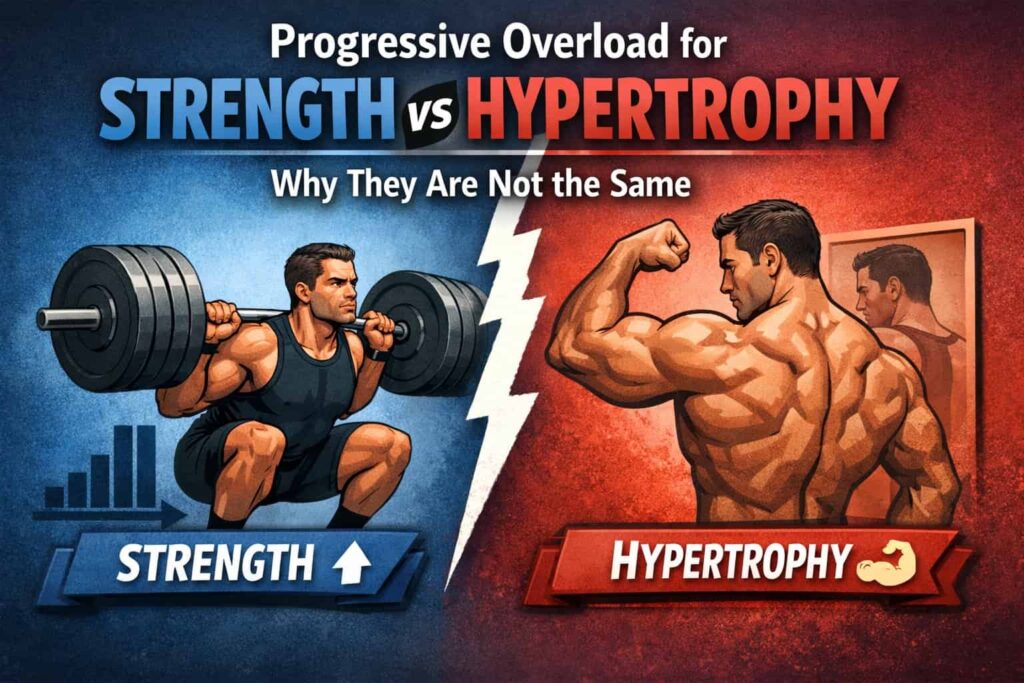
Strength training and hypertrophy training share overlap, but they are not identical. One focuses on performance output. The other focuses on structural change inside the muscle.
If you do not understand this difference, you may:
- Chase heavier weights when your goal is muscle size
- Train too light when your goal is maximal strength
- Manipulate the wrong variables
- Plateau earlier than necessary
In this article, we will break down:
- What progressive overload actually means
- How strength adaptation differs from hypertrophy adaptation
- Which training variables matter most for each goal
- How to apply progressive overload correctly for muscle growth
- How to apply progressive overload correctly for strength gains
Once you understand this, your programming becomes intentional.
And intentional training produces better results.
What Is Progressive Overload and Why It Drives Adaptation
Progressive overload is the foundation of resistance training. Without it, there is no continued muscle growth, no strength gains, and no long-term improvement.
At its core, progressive overload means gradually increasing training stress over time.
The human body is built for survival. It constantly works to maintain balance, a state known as homeostasis. When you train, you disturb that balance. The stress from resistance training forces the body to adapt. Muscles repair and grow. The nervous system becomes more efficient. Connective tissues strengthen.
But here is the critical point:
Once your body adapts to a specific level of stress, that same stimulus is no longer enough to force further adaptation.
If you lift the same weight, for the same reps, with the same effort every week, your body has no reason to improve. It has already solved that problem.
Progress stops.
This is why training must become progressively more demanding.
In practical terms, progressive overload in strength training and hypertrophy training can involve:
- Increasing load (more weight on the bar)
- Increasing repetitions with the same load
- Increasing total training volume (more sets per muscle group per week)
- Increasing intensity (training closer to failure)
- Improving lifting technique and efficiency
However, progressive overload does not mean blindly adding weight every session. It means strategically manipulating training variables to continue disrupting homeostasis.
The amount of stress required to create adaptation increases as you become more trained. A beginner may grow from minimal volume and moderate intensity. An advanced lifter requires greater precision, higher quality effort, and smarter programming.
This is where many lifters fail. They understand the concept of progressive overload, but they do not understand how to apply it differently depending on their goal.
Because progressive overload for building muscle size is not identical to progressive overload for maximizing strength.
To understand that difference, we first need to examine what hypertrophy actually is and how it occurs inside the muscle tissue.
Hypertrophy Explained: Structural Muscle Growth and Myofibrillar Adaptation
Muscle hypertrophy refers to an increase in muscle size, but the process is more detailed than simply “building bigger muscles.” The primary mechanism responsible for growth in resistance training is known as myofibrillar hypertrophy, which involves an increase in the number and size of myofibrils within individual muscle fibers. Myofibrils are the contractile components of muscle tissue, composed of actin and myosin filaments that generate force during contraction. When these structures increase in density, the muscle fiber itself becomes thicker, resulting in a visible increase in overall muscle size.
As resistance training applies sufficient mechanical tension to muscle fibers, it disrupts internal balance and signals the body to adapt. The adaptation occurs through protein synthesis, where new contractile proteins are added to existing fibers. Over time, repeated exposure to properly programmed stress leads to a measurable increase in muscle cross-sectional area. This structural change is what defines hypertrophy training outcomes.
Although other forms of growth such as sarcoplasmic hypertrophy and hyperplasia are often discussed, their role in human muscle development is less clearly defined. For practical purposes, effective hypertrophy training focuses on increasing contractile tissue through consistent mechanical tension, adequate training volume, and sets performed close to muscular failure.
The most important distinction to understand is that hypertrophy is a structural adaptation rather than a direct performance goal. The objective is not to lift the maximum possible load, but to apply sufficient stress to the target muscle so that it remodels and grows. While increases in strength often occur alongside muscle growth, they are typically a secondary effect of increased muscle mass rather than the primary target of hypertrophy-focused programming.
Understanding hypertrophy as a structural change within muscle tissue sets the foundation for recognizing how it differs from strength adaptation, which relies heavily on neural efficiency and force production rather than purely on muscle size.
- Hypertrophy refers to an increase in muscle size.
- The primary mechanism is myofibrillar hypertrophy, which increases the number and size of contractile proteins inside muscle fibers.
- Growth occurs when mechanical tension disrupts muscle homeostasis and stimulates protein synthesis.
- As myofibrils increase, muscle fiber diameter expands, leading to a thicker muscle.
- Hypertrophy is a structural adaptation, not a direct performance outcome.
- The goal of hypertrophy training is to maximize muscle stress, not simply lift heavier weights.
- Strength gains may occur alongside muscle growth, but they are typically a secondary effect.
Strength Explained: Neural Adaptations and Force Production
Strength refers to the ability of the body to produce maximum force against resistance. In resistance training, strength is commonly measured through performance outcomes such as a one-repetition maximum, which reflects the greatest amount of weight an individual can lift in a single effort. Unlike hypertrophy, which focuses on increasing muscle size, strength training is primarily concerned with improving force output regardless of changes in physical appearance or muscle thickness.
Strength development is influenced by two major factors: muscle size and neural adaptations. Larger muscles generally have a greater potential to produce force because they contain more contractile tissue. When muscle mass increases, the total number of fibers contributing to force production also increases, which supports improvements in overall strength. However, muscle size alone does not fully determine how strong a person can become.
Neural adaptations play a crucial role in strength development by improving how efficiently the nervous system activates muscle tissue. The nervous system controls muscle contraction by recruiting motor units, which are groups of muscle fibers activated by a single nerve. As training progresses, the body becomes more effective at recruiting a larger number of motor units simultaneously, allowing greater force production. Improvements also occur in rate coding, which refers to how quickly motor units fire, as well as coordination between muscle groups and overall lifting technique.
These neural improvements are highly specific to the movements being trained. Strength gains are strongly influenced by practicing the exact lifts that an individual wants to improve. Training with heavy loads enhances neural efficiency and teaches the body to generate force in a coordinated and effective manner. This specificity explains why strength athletes frequently perform the same compound lifts to maximize performance outcomes.
Because strength relies heavily on neural efficiency, training strategies often emphasize heavier loads, lower repetition ranges, and sufficient rest periods to maintain performance quality. Understanding how neural adaptations influence force production helps explain why progressive overload is applied differently when the primary goal is strength rather than muscle growth.
- Strength refers to the ability to produce maximum force against resistance.
- Strength is commonly measured through performance outcomes such as one-repetition maximum lifts.
- Muscle size contributes to strength by increasing total contractile tissue.
- Neural adaptations improve the nervous system’s ability to activate muscle fibers efficiently.
- Strength gains involve improved motor unit recruitment, rate coding, coordination, and technique.
- Neural adaptations are movement-specific, requiring practice of target lifts.
- Strength training typically emphasizes heavy loads, lower rep ranges, and longer rest periods.
Key Training Variables: Exercise Selection, Rep Ranges, Volume, and Rest
Although strength and hypertrophy training overlap significantly, the manipulation of key training variables determines which adaptation is prioritized. The most important variables include exercise selection, repetition range and load, total training volume, and interset rest periods. While both goals require progressive overload, the way these variables are adjusted differs depending on whether the objective is maximizing muscle size or maximizing force output.
Exercise selection plays a different role depending on the training goal. For hypertrophy, there are no mandatory exercises because muscle growth depends on effectively loading the target muscle through mechanical tension. A variety of movements can stimulate similar growth outcomes as long as the muscle is trained close to failure with sufficient volume. In contrast, strength training relies heavily on specificity. Since neural adaptations are task-specific, improving performance in a particular lift requires practicing that exact movement pattern. If the goal is to increase a squat or bench press one-repetition maximum, those lifts must be trained consistently with appropriate intensity.
Repetition range and load also differ between the two approaches. Hypertrophy can occur across a wide spectrum of rep ranges, generally from moderate to high repetitions, provided sets are taken close to muscular failure. The absolute load is less important than the level of effort and tension experienced by the muscle fibers. Strength training, however, demands heavier loads and lower repetition ranges because neural efficiency improves most effectively when the nervous system is challenged with high-intensity efforts. Training in lower rep ranges with substantial load allows the body to adapt to producing maximal force.
Training volume, typically measured as total sets per muscle group or lift per week, has a strong relationship with hypertrophy. Research supports a dose-response relationship in which higher quality volume leads to greater muscle growth, assuming recovery is managed properly. For strength, volume remains important over the long term because muscle size contributes to force potential. However, short-term neural adaptations depend more on intensity than on total weekly sets. Heavy, focused practice is often more influential than simply increasing the number of sets performed.
Interset rest periods further distinguish the two approaches. For hypertrophy, moderate rest intervals are generally sufficient to maintain performance while preserving metabolic stress and mechanical tension. Small differences in rest duration appear to have limited impact on overall muscle growth as long as total effort is maintained. In strength training, rest periods are more critical because incomplete recovery reduces the ability to lift heavy loads. Longer rest intervals allow the nervous system to recover fully, ensuring high-quality performance and maximizing neural adaptations.
Understanding how these variables interact provides clarity on why progressive overload must be tailored to the specific adaptation being pursued. Manipulating exercise selection, rep ranges, volume, and rest strategically ensures that training stress aligns with either structural muscle growth or maximal strength development.
- Exercise selection is flexible for hypertrophy but highly specific for strength.
- Hypertrophy can occur across a wide rep range if sets are close to failure.
- Strength training requires heavier loads and lower rep ranges.
- Volume strongly influences muscle growth through a dose-response relationship.
- Intensity plays a larger role than volume in short-term neural strength gains.
- Rest periods are moderately important for hypertrophy but critical for maximizing strength performance.
How Progressive Overload Differs for Strength vs Hypertrophy Training
Progressive overload is essential for both strength and hypertrophy, but its application differs depending on the desired adaptation. While both approaches require increasing training stress over time, the intent behind that increase is not the same. Strength training is performance-driven, meaning progress is measured by the amount of weight lifted. Hypertrophy training is structure-driven, meaning progress is measured by changes in muscle size rather than purely by load on the bar.
In strength training, progressive overload is direct and intentional. The primary objective is to lift heavier weights over time. If load does not gradually increase across training cycles, strength is not improving. Programming often reflects this by starting with higher volume phases that support muscle growth and technical practice, then gradually reducing volume while increasing intensity as the athlete approaches peak performance. The shift toward heavier loads and lower repetitions enhances neural efficiency, allowing the lifter to express maximal force. In this model, increasing the weight lifted is the central goal, and all training variables are adjusted to support that outcome.
Hypertrophy training applies progressive overload differently because the goal is to maximize muscle stress rather than maximize external load. Mechanical tension, sufficient volume, and proximity to failure are the primary drivers of muscle growth. As long as the muscle experiences high-quality tension and adequate stimulus, hypertrophy can occur even if the weight on the bar does not change dramatically. Over time, as muscle fibers grow, strength improvements may occur naturally. However, these performance increases are considered a result of muscle growth rather than the main objective.
This distinction creates an important practical difference. In strength training, lifters may intentionally manipulate variables to increase load, even if volume decreases. In hypertrophy training, consistency in execution, strict technique, and sustained effort across sets often matter more than aggressively increasing weight. Chasing heavier loads at the expense of technique or muscle tension can reduce the effectiveness of hypertrophy-focused training.
Ultimately, progressive overload for strength means purposefully increasing performance capacity. Progressive overload for hypertrophy means consistently applying sufficient muscular stress so that structural adaptation occurs. Both require intelligent programming, but the metric of success differs. Understanding this distinction prevents misapplication of training principles and allows lifters to align their programming with their true goal.
- Progressive overload is necessary for both strength and hypertrophy.
- Strength training focuses on increasing load and performance output over time.
- Hypertrophy training focuses on maximizing muscle stress and structural growth.
- Strength programming often shifts from higher volume to higher intensity phases.
- Hypertrophy programming emphasizes consistent tension, sufficient volume, and proximity to failure.
- Performance improvements drive strength gains, while muscle growth drives hypertrophy gains.
Frequently Asked Questions
Progressive overload in strength training refers to gradually increasing the load lifted over time to improve maximal force production. This typically involves adding weight to compound lifts, training in lower rep ranges, and focusing on improving one-rep max performance through higher intensity training.
In hypertrophy training, progressive overload means increasing muscular stress over time rather than simply adding weight. This can involve increasing total volume, performing more reps with the same load, improving proximity to failure, or enhancing exercise execution to maximize mechanical tension for muscle growth.
Lifting heavier is not always required for muscle hypertrophy. Muscle growth can occur across a wide rep range as long as sets are taken close to failure and sufficient training volume is achieved. Increasing load can help, but mechanical tension and effort are more important than absolute weight.
Hypertrophy can be achieved effectively within approximately 6 to 25 repetitions per set, provided the sets are performed close to muscular failure. Moderate rep ranges are commonly used, but high effort and adequate weekly volume are the primary drivers of muscle growth.
Strength gains are typically maximized in lower rep ranges, often between 1 to 5 repetitions per set. Heavy loads improve neural adaptations such as motor unit recruitment and rate coding, which enhance maximal force production.
Training close to failure is important for hypertrophy because it ensures sufficient muscle fiber recruitment and mechanical tension. However, constantly training to absolute failure may increase fatigue and reduce recovery capacity, so it should be programmed strategically.
Muscle hypertrophy generally responds to higher weekly training volume per muscle group. A moderate to high number of quality sets performed with proper intensity supports a dose-response relationship, provided recovery, nutrition, and sleep are adequate.
For short-term neural strength gains, intensity is more important than volume. Lifting heavy loads improves neural efficiency and force output. Volume becomes important long term because increased muscle mass contributes to strength potential.
For hypertrophy training, rest periods between one and three minutes are usually sufficient. These rest intervals allow recovery while maintaining training density and mechanical tension needed for muscle growth.
Strength training typically requires longer rest periods, often three to six minutes for compound lifts. Longer rest allows greater recovery of the nervous system, enabling higher load performance and improved neural adaptations.
Yes, strength can increase without significant muscle growth due to neural adaptations. Improved motor unit recruitment, coordination, and technique can enhance force production even when muscle size remains relatively stable.
Muscle growth often leads to some strength increase, but hypertrophy-focused training does not prioritize maximal load progression. Strength may improve gradually as muscle mass increases, but it is not the primary objective.
Progressive overload may stall if recovery, nutrition, sleep, or training quality are inadequate. Overuse of volume, insufficient proximity to failure, or lack of variation in training variables can also limit adaptation over time.
Beginners often benefit from a balanced approach that includes both hypertrophy and strength training. Early gains typically involve both neural adaptations and muscle growth, making foundational compound movements and consistent volume highly effective.
A common mistake is chasing heavier weights at the expense of technique and muscle tension. For hypertrophy, this can reduce effective muscle stimulation. For strength, failing to train with sufficient intensity and specificity can limit neural adaptation and maximal force development.