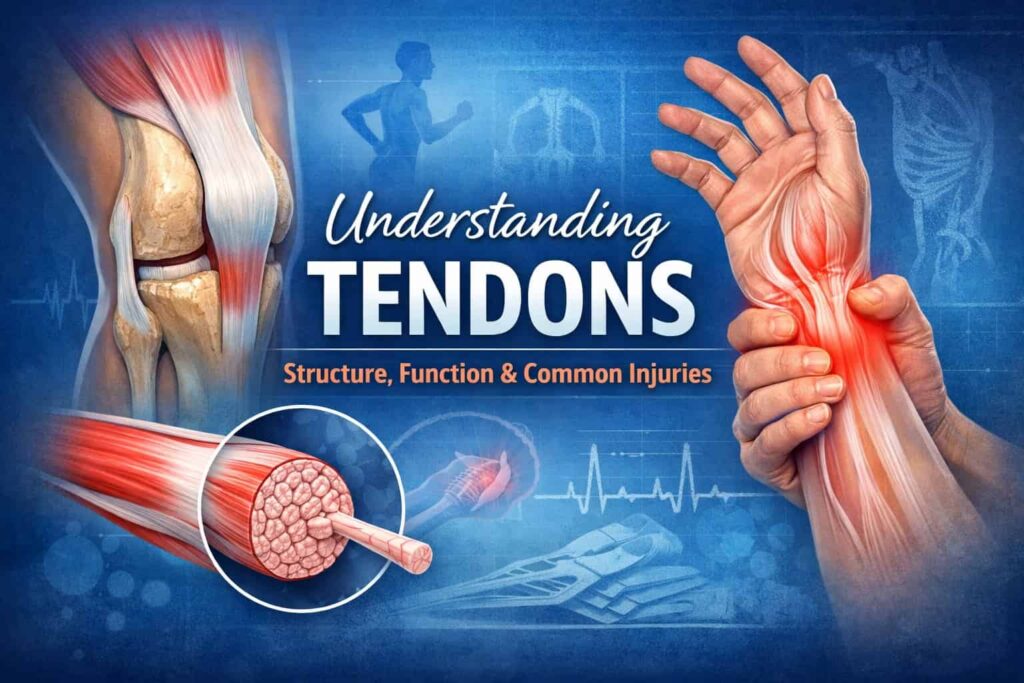
Many gym athletes believe a tendon injury will heal in 36 hours if they just “push through.” This mindset is one of the biggest reasons minor elbow pain turns into long-term tendinopathy. Tendons heal slowly, follow strict biological timelines, and do not respond to motivation. Understanding how tendons work is essential for preventing chronic injuries and staying consistent with training.
What Are Tendons and Why They Matter
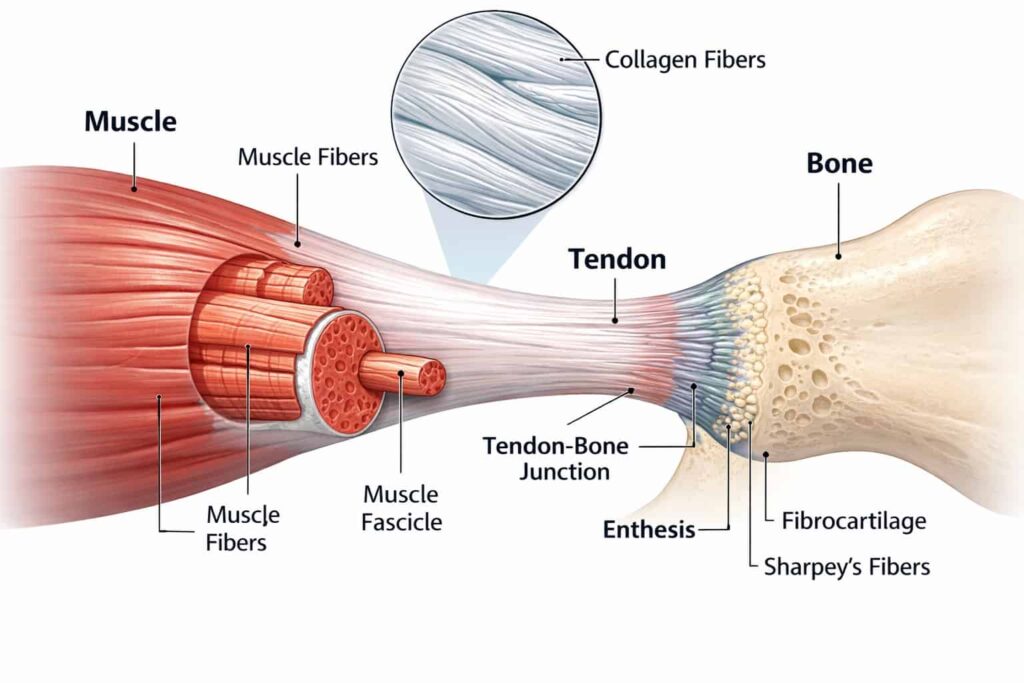
Tendons are not just random strings holding your body together. They are dense connective tissues made mostly of collagen, and their only job is to transfer force. That’s it. No pump. No mirror muscles. No glory. Just brutal mechanical work.
Ligaments connect bone to bone.
Fascia connects muscle to muscle.
Tendons connect muscle to bone, which means every single rep you do has to pass through them first.
When your muscle contracts, it doesn’t move your skeleton directly. The force travels through the tendon, and the tendon pulls on the bone. That’s how a bicep curl happens. That’s how you deadlift. That’s how you even open a door. Without tendons, your muscles would just contract in place like useless engine revs with no wheels.
This is why tendons matter more than your muscles when it comes to longevity. Muscles are flashy and adapt fast. Tendons are slow, stubborn, and unforgiving. They don’t care how strong your muscle is. If the tendon can’t handle the force, the system fails.
Think of tendons like steel cables in a crane. The motor can be powerful, but if the cable is worn out, frayed, or overloaded, the whole thing snaps. And unlike muscles, tendons don’t bounce back quickly. They remodel slowly, and they remember abuse.
Tendons also have to deal with repeated loading, not just max force. Pull-ups, rows, curls, dips — these hit the same tendon over and over again. If recovery doesn’t keep up, micro damage accumulates. You don’t feel it at first. Then one day, strength drops, pain appears, and suddenly you’re “injury prone.”
You’re not injury prone.
You’re tendon-blind.
That clicking, aching, or burning sensation isn’t weakness. It’s your tendon telling you it’s being asked to do more work than it’s structurally prepared for. Ignore that message long enough, and the tendon stops cooperating altogether.
Muscles make you look strong.
Tendons decide whether you get to keep training.
You may also like: Muscle Damage Is Not the Main Driver of Muscle Growth: What Science Actually Says
Tendon Structure Explained Simply (Why Collagen Alignment Decides Your Fate)
A tendon isn’t one solid rope. It’s a rope made of smaller ropes, stacked inside each other like some evil engineering experiment designed to punish impatience.
At the top level, you have the tendon itself. Inside that are large bundles. Inside those are smaller bundles. Inside those are even smaller bundles. And at the very bottom of this mess are the collagen fibers — the only part actually doing the work.
In a healthy tendon, those collagen fibers are packed tightly and lined up perfectly parallel. Not messy. Not crossed. Not chaotic. Parallel. Like organized cables in a high-tension system. That alignment is what allows a tendon to handle massive force without failing.
Now here’s where you screw it up.
When a tendon gets injured, that neat parallel structure starts breaking down. Microtears form. Fibers lose alignment. Instead of lying neatly in the same direction, they become disorganized and scattered. That immediately reduces strength, even if the tendon looks “fine” from the outside.
And your body does try to repair it. New collagen gets laid down. But collagen doesn’t magically line itself up correctly. It follows the direction of stress you put on it during healing.
This is why training through pain is such a bad idea. If you keep loading a damaged tendon with sloppy form, fatigue, or excessive volume, the collagen fibers heal in random directions. You don’t get a strong tendon back. You get a thicker, weaker, uglier tendon that hurts under load.
That’s what chronic tendon pain really is.
Not inflammation.
Not tightness.
Structural chaos.
Once collagen alignment is messed up, force transfer becomes inefficient. Your muscles pull hard, but the tendon can’t transmit that force cleanly. Strength drops. Pain appears. And now you’re stuck in a loop where every workout makes things worse instead of better.
Tendon rehab isn’t about “resting until pain goes away.”
It’s about forcing collagen to line up properly again.
And if you don’t understand this, you’ll keep wondering why your elbow “never fully healed” even after weeks off.
Tendons Are Not Just Ropes — They Are Springs
Most people think tendons just connect muscle to bone and sit there doing nothing. Wrong. Tendons are elastic, and that elasticity is one of the reasons your body can move efficiently instead of feeling like a rusty robot.
When you run, jump, or even lower a weight, your tendons store energy. When you land from a jump, the tendon stretches slightly and absorbs force. On the push-off, it releases that stored energy and helps propel you upward. Same thing happens in sprinting, plyometrics, and even controlled strength training.
This spring-like behavior is a huge deal. It reduces how much work your muscles need to do and protects your joints from brutal impact forces. A healthy tendon acts like a shock absorber and a power amplifier at the same time.
Now here’s the problem.
An injured tendon loses this elastic ability. When the collagen fibers are damaged or disorganized, the tendon becomes stiffer in the wrong way. It doesn’t stretch smoothly, and it doesn’t recoil efficiently. Instead of acting like a spring, it behaves like a cracked rubber band.
That means two bad things happen at once.
First, more stress gets dumped directly onto the tendon because it can’t distribute load properly.
Second, your muscles have to work harder to compensate, which increases force going through the same damaged tendon.
This is why jumping, running, and explosive lifting feel awful when a tendon is injured. It’s not just pain. It’s mechanical failure. The system that’s supposed to recycle energy is broken, so everything feels heavier, slower, and more stressful.
And if you keep training explosively on a damaged tendon, you’re not “building resilience.” You’re repeatedly yanking on a structure that’s already lost its spring. That’s how small tendon issues turn into Achilles ruptures, jumper’s knee, or elbows that never stop aching.
A healthy tendon makes movement efficient.
An injured tendon makes every rep a debt payment.
Ignore that, and the interest compounds fast.
You may also like: The Best Exercise for Weight Loss: Loose Weight Quickly
How Tendon Injuries Actually Happen (Microtears, Overload, and Ego Lifting)
Tendons are built to handle repetitive loading. That’s literally their job. Pull-ups, rows, curls, presses — your tendons can take thousands of reps over time if the load matches their capacity.
The problem starts when the load exceeds what the tendon can currently handle.
Every hard session creates microtears in tendon tissue. That’s normal. That’s how adaptation starts. Your body repairs those microtears by laying down new collagen, making the tendon slightly stronger than before.
But here’s the part nobody respects.
That repair process takes time. And if you load the tendon again before it finishes repairing, you’re stacking damage on top of damage. At that point, the rate of injury becomes faster than the rate of healing. The tendon never catches up.
This is how a “small tweak” turns into chronic pain.
It’s usually not one heavy rep that ruins a tendon. It’s volume abuse. Too many sets. Too many sessions. Too many exercises hitting the same tendon pattern week after week. Same grip. Same angle. Same joint stress. No variation. No recovery.
Add bad form on top of that, and you’re basically sandpapering your tendon every workout.
What makes it worse is that tendons don’t scream early. Muscles burn. Tendons whisper. A little ache. A little stiffness. A quiet clicking sound you pretend isn’t there. So you keep training, because “it’s not that bad.”
Until one day, strength drops off a cliff. Now pulling feels weak. Pressing hurts. Daily tasks feel harder than training used to. And suddenly you’re Googling “why does my elbow hurt” like this came out of nowhere.
It didn’t.
You didn’t respect load management.
You didn’t respect recovery.
And you definitely didn’t respect progression.
Tendon injuries aren’t bad luck. They’re math. And if you keep adding stress without subtracting recovery, the outcome is guaranteed.
The 10-Minute Rule (Why More Work Doesn’t Make Your Tendons Stronger)
Here’s the part nobody wants to hear: your tendons stop getting stronger way earlier than you think.
Research shows that tendons respond to loading for roughly 10 minutes. During that window, they receive the mechanical signal to adapt — to lay down new collagen and increase stiffness in a good way. After that? The signal shuts off.
Once you pass that point, you’re not “building tendon strength” anymore. You’re just accumulating damage.
So when you’re doing endless sets, marathon calisthenics sessions, or high-rep burnout work for the same joint, you’re not being disciplined. You’re being reckless. Your muscles might still be fine, but your tendons have already checked out.
This is why people with insane work capacity still end up injured. They assume if they’re not exhausted, they’re still adapting. Tendons don’t work like that. They adapt fast to short, controlled loading, not endless punishment.
Think of it like this:
Your tendon hears the “get stronger” message early in the session. After that, every extra rep is just wear and tear with no upside.
And this is where calisthenics, climbing, and high-volume training really mess people up. You hang, pull, grip, and load the same tendon pattern for 30–60 minutes straight, believing you’re building bulletproof joints. In reality, you peaked early and then spent the rest of the session grinding your tendon down.
That’s how you end up with elbows that feel fine during warm-ups but fall apart halfway through a workout. The tendon was already fatigued at the tissue level long before your muscles noticed.
More work ≠ stronger tendons.
Smarter loading does.
If you want tendon resilience, you don’t need longer sessions. You need precise stress, enough recovery, and the discipline to stop when the adaptation window closes.
Tendinitis vs Tendinopathy (Acute Pain vs Long-Term Damage)
Doctors love throwing these words around, and most lifters nod like they understand them. They don’t. So let’s simplify it without sugarcoating.
Tendinitis means you pissed the tendon off recently.
It’s acute inflammation from a new overload or bad session. The tissue is irritated, swollen, and sensitive — but the structure is mostly still intact. This is the phase where healing is fastest if you stop being an idiot.
Tendinopathy is what happens when you ignore tendinitis.
At that point, the problem isn’t inflammation anymore. It’s degeneration. The collagen fibers are disorganized, weaker, and less capable of handling load. Blood supply is worse. Healing slows down. Pain becomes unpredictable. Some days feel okay. Some days feel terrible for no clear reason.
That’s why chronic tendon pain is so frustrating. It’s not a clean injury anymore. It’s a damaged system.
And here’s the part that messes with people’s heads:
That inflammation you feel early on? That’s not the enemy. That’s your body trying to heal. Increased blood flow brings nutrients and repair cells to the area. Pain is the signal telling you to change how you’re loading the tendon.
The real damage happens when you keep training the same movement pattern while inflamed. Every time you do, you tear apart the early repair work your body just started. So the tendon never finishes healing. It just stays stuck in a half-broken state.
That’s why “rest until it feels better” fails. Pain can drop before the structure is restored. You feel good, train again, and blow the whole thing up.
If you catch it at tendinitis, recovery is relatively quick.
If you wait until tendinopathy, you’re signing up for months of rehab.
Same tendon.
Different consequences.
One bad decision apart.
Real Tendon Healing Timelines (Why 36 Hours Is Pure Fantasy)
Your tendon does not heal because you “took two days off.”
It doesn’t rebuild because you iced it once and stretched a little.
And it definitely doesn’t care how motivated you feel on leg day.
Tendon healing happens in phases, and every phase takes time whether you like it or not.
The first phase is initial repair. This starts within a few days after injury. Inflammation increases, blood flow improves, and your body begins patching the damaged collagen. This phase is about damage control, not strength.
The second phase is remodeling. This is where things get slow. New collagen fibers are laid down and gradually reorganized based on how the tendon is loaded. This phase takes weeks, not days. And if you overload the tendon here, you erase progress instantly.
The final phase is maturation. This is where collagen thickens, aligns properly, and regains tensile strength. This can take anywhere from 6 weeks to 6 months, sometimes longer for chronic injuries.
So no, your tendon didn’t heal in 36 hours.
It just stopped screaming long enough for you to hurt it again.
This is why people swear their injury “never fully healed.” It didn’t get the time or the correct loading to finish the job. Tendons remodel slowly because collagen turnover is slow. That’s biology, not weakness.
Your vacation deadline doesn’t matter.
Your meet date doesn’t matter.
Your tendon doesn’t negotiate.
You either respect the timeline, or you extend it.
What Actually Works for Tendon Healing (And What’s Mostly BS)
Let’s get this straight first: rest alone doesn’t heal tendons. It calms symptoms. That’s it. If you just stop training and wait for pain to disappear, you’re setting yourself up for the same injury the moment you load the tendon again.
Tendons heal through controlled stress, not avoidance.
The most effective tool we have is eccentric loading. That’s when the muscle lengthens under tension — like slowly lowering the weight during a bicep curl instead of rushing through it. This kind of loading sends a clear signal for collagen fibers to realign in the correct direction.
Eccentrics work because they:
- Increase tendon stiffness in a good way
- Improve collagen organization
- Tolerate load without explosive stress
That’s why almost every modern tendon rehab protocol includes them.
Movement also matters more than people think. Gentle motion increases blood flow, keeps the tissue from stiffening, and helps guide healing fibers into parallel alignment. Light stretching and controlled mobility help — aggressive stretching does not.
Massage and soft tissue work don’t “fix” tendons, but they can reduce surrounding tension and improve tolerance to movement. Think of them as support tools, not cures.
Now for the BS.
Painkillers don’t heal tendons.
Cortisone injections reduce pain but can weaken tendon tissue.
Icing doesn’t rebuild collagen.
“Training through it” doesn’t build toughness — it builds scar tissue.
The goal isn’t zero pain. The goal is progressive load without flare-ups. Slight discomfort is sometimes acceptable. Sharp pain, loss of strength, or worsening symptoms are not.
Tendon rehab is boring. It’s slow. It doesn’t give you a pump. And that’s exactly why it works.
Why Most Tendon Injuries Are Completely Preventable
Most tendon injuries don’t come from bad genetics or bad luck. They come from bad decisions repeated consistently.
You skip progressions. You jump straight to advanced movements because your muscles can handle them, even though your tendons aren’t ready. Muscles adapt fast. Tendons don’t. And that mismatch is where injuries live.
You chase volume instead of quality. Same grips. Same angles. Same exercises. Week after week. Your tendon never gets a break from the exact stress pattern that’s breaking it down. That’s not discipline — that’s lazy programming.
You train with trash form. Half reps, sloppy control, bouncing out of the bottom, relying on momentum. Every one of those reps sends chaotic force through the tendon. Over time, that chaos adds up.
You ignore early warning signs. Clicking. Morning stiffness. Localized tenderness. Slight strength loss. Those aren’t quirks. They’re early damage reports. And you ignore them because the pain isn’t “bad enough yet.”
Then you act shocked when the tendon finally gives up.
Good training builds tendons before it demands performance from them. That means gradual loading, controlled eccentrics, smart volume limits, and actual technique standards. Not vibes. Not ego. Not “I’ve always trained like this.”
The athletes who stay pain-free aren’t tougher. They’re smarter. They respect progression. They respect recovery. And they stop pretending their tendons care about their goals.
Ignore this, and you’ll end up injured, frustrated, and Googling rehab protocols you could’ve avoided.
Respect it, and you’ll still be training years from now — instead of explaining to people how you “used to lift.”
References
- Basic Research on Tendon Repair: Strategies, Evaluation, and Development
- Tendon injury and repair – A perspective on the basic mechanisms of tendon disease and future clinical therapy
- Rehabilitation and Return to Sports after Achilles Tendon Repair
- Achilles Tendon Ruptures and Repair in Athletes—a Review of Sports-Related Achilles Injuries and Return to Play
FAQs (Frequently Asked Questions)
Tendon healing time usually ranges from 6 weeks to 6 months depending on injury severity, tendon load, and rehab quality. Tendons do not heal in 36 hours, even if pain temporarily disappears.
Elbow tendon pain from gym training can take several weeks to months to heal. Recovery depends on reducing aggravating exercises, improving form, and following proper tendon rehab protocols.
Elbow tendon pain can heal without quitting the gym, but the exact movement pattern causing the injury must be stopped. Training volume and intensity must be adjusted to protect the tendon.
Elbow clicking during pull-ups or curls is often a sign of tendon irritation or collagen fiber disorganization. Continued loading can worsen tendon damage and lead to chronic elbow pain.
Tendinitis refers to acute tendon inflammation from recent overload. Tendinopathy describes long-term tendon degeneration caused by repeated reinjury and poor healing.
Tendons heal slower than muscles because they have limited blood supply and rely on slow collagen remodeling, which takes significantly more time than muscle repair.
Eccentric exercises are the most effective for tendon healing because they help collagen fibers realign correctly and improve tendon strength without excessive stress.
Complete rest may reduce pain but does not fully heal tendons. Controlled loading and gradual reintroduction of movement are necessary for proper tendon recovery.
Tendon pain often returns because pain reduction occurs before structural healing is complete. Returning to normal training too early can reinjure the tendon.
Excessive training volume beyond the tendon’s adaptation window increases damage without added benefit, raising the risk of overuse tendon injuries.
Poor lifting form increases uncontrolled force through the tendon, leading to microtears, collagen breakdown, and long-term tendon pain.
Gentle stretching may improve circulation, but aggressive stretching can worsen tendon damage, especially during early healing stages.
Painkillers may reduce discomfort but do not repair tendon tissue and can hide symptoms, increasing the risk of further injury.
If tendon pain lasts longer than two to three weeks, worsens, or causes strength loss, an orthopedic or sports medicine doctor should be consulted.
Most tendon injuries are preventable with proper technique, gradual progression, controlled training volume, and respecting tendon recovery timelines.